
Configure Webhook
NOTE
If you want to use webhook, please bind KV first and configure the worker variable ENABLE_WEBHOOK = true
If you want webhook to have stronger email parsing capabilities, refer to Configure worker to use wasm for email parsing
Prerequisites
You need to set up your own webhook service or use a third-party platform. This service needs to be able to receive POST requests and parse json data.
This project uses songquanpeng/message-pusher as an example webhook service.
- You can use the service provided by msgpusher.com
- You can also self-host the
message-pusherservice, refer to songquanpeng/message-pusher
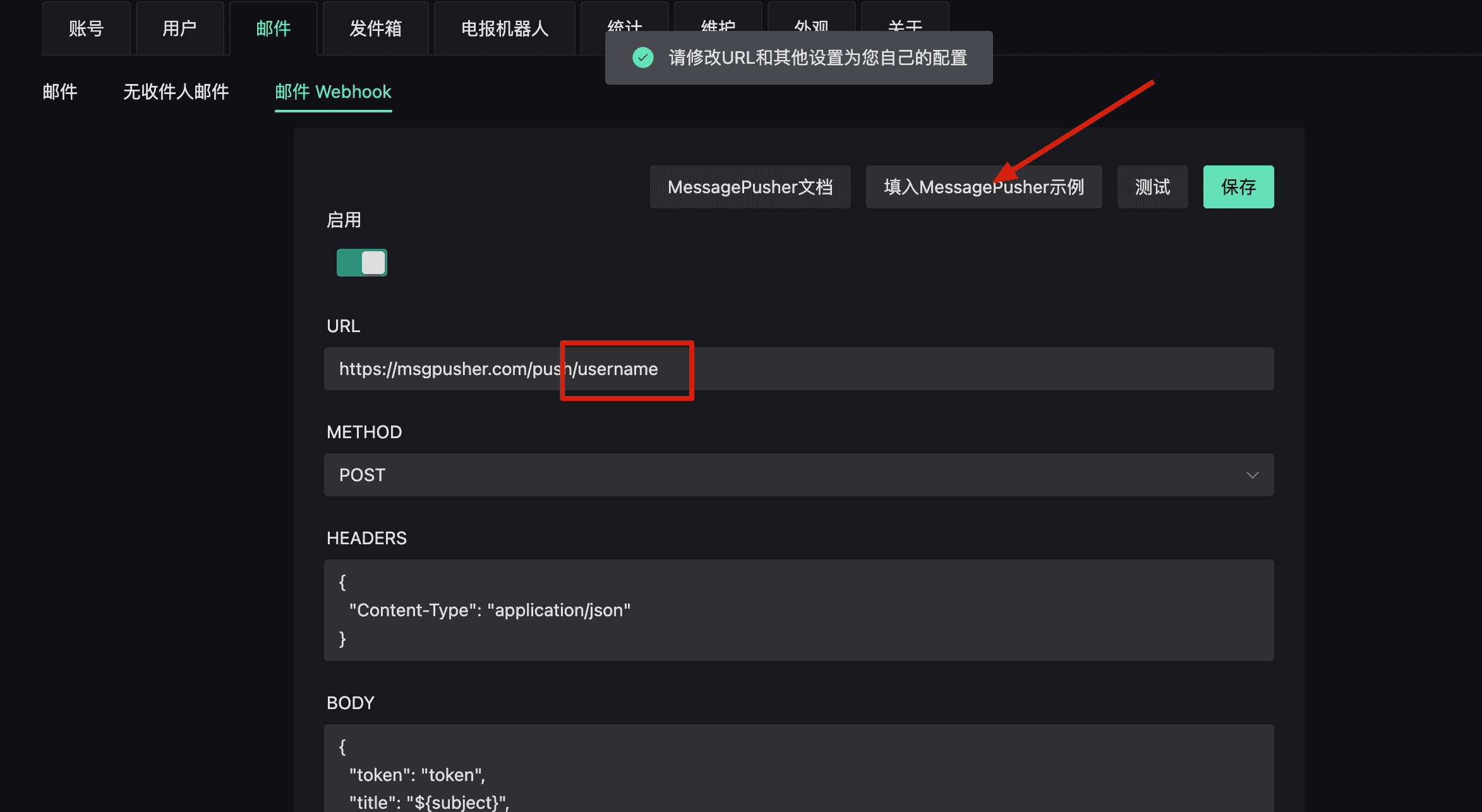
Admin Configure Global Webhook
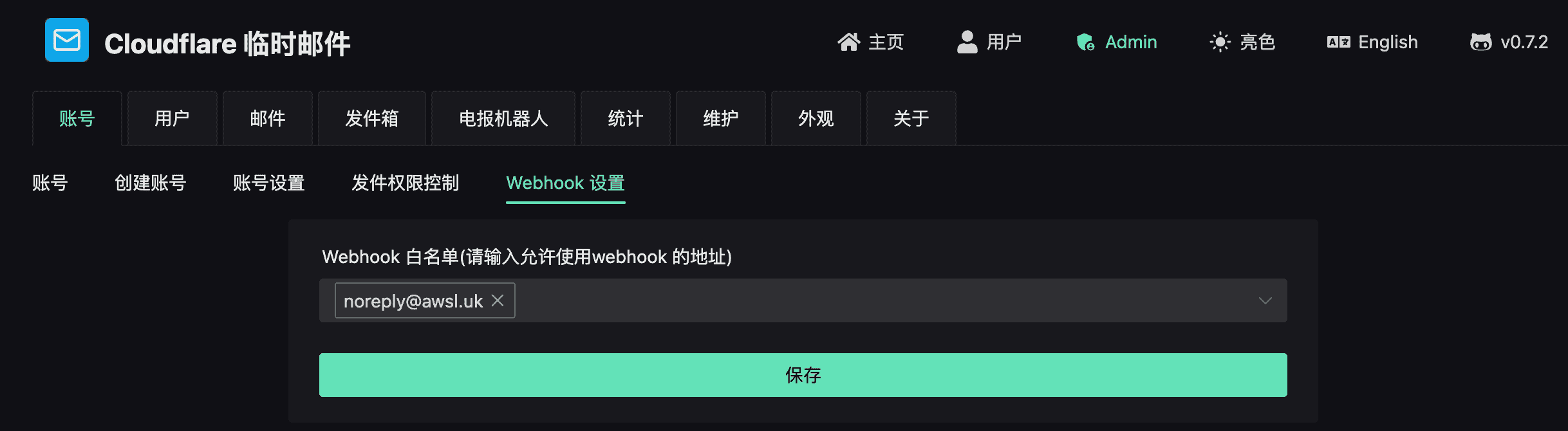
Admin Allow Email to Use Webhook
Configure Webhook for a Specific Email
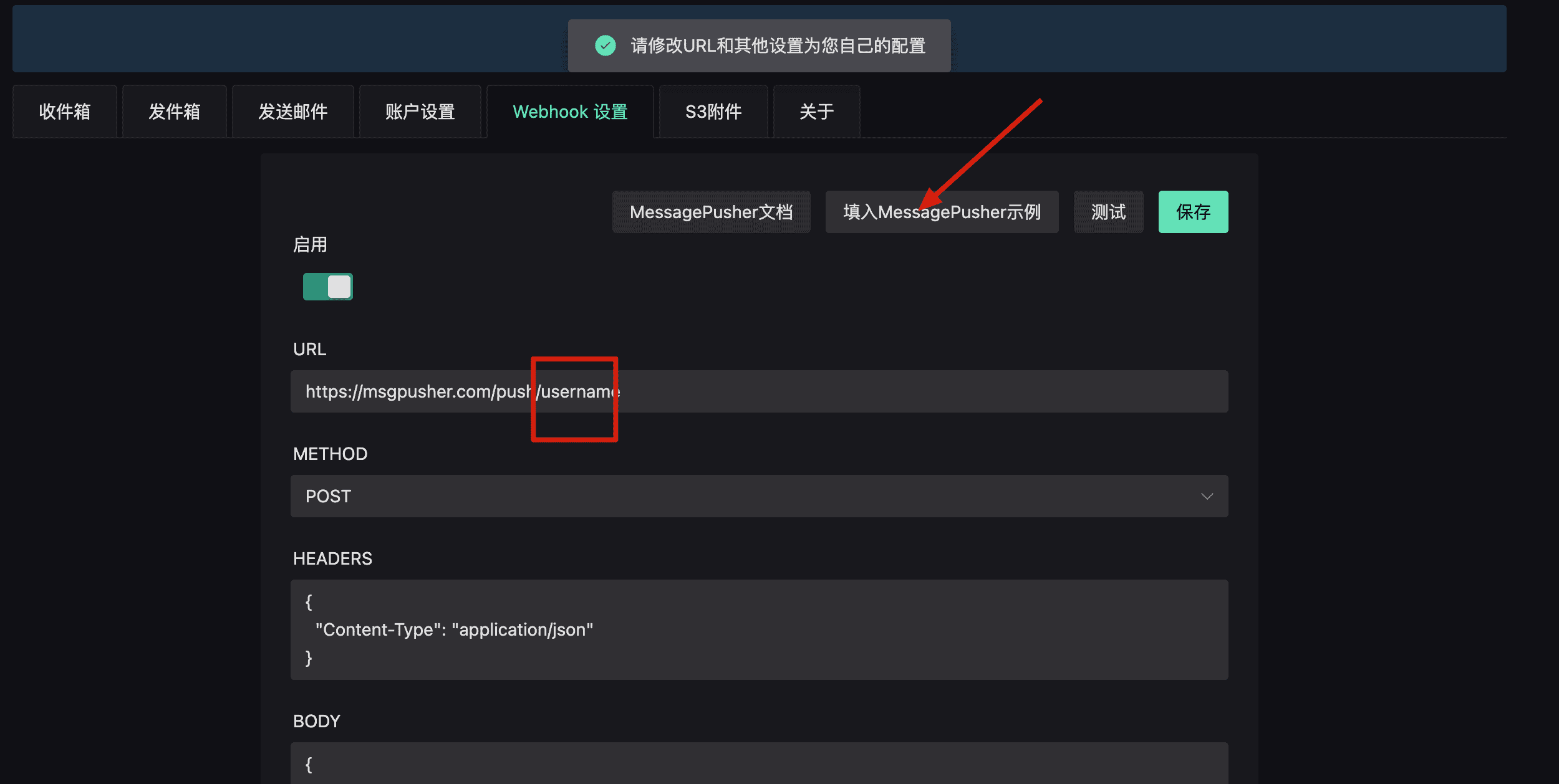
Webhook Template Examples
Telegram Bot Push
Push email notifications by calling the Telegram Bot API directly via webhook. Suitable for scenarios where you don't want to deploy the full Telegram Bot integration or need a custom push format.
- URL:
https://api.telegram.org/bot<YOUR_BOT_TOKEN>/sendMessage - Method:
POST - Headers:
{
    "Content-Type": "application/json"
}- Body:
{
    "chat_id": "YOUR_CHAT_ID",
    "text": "New Email\nFrom: ${from}\nTo: ${to}\nSubject: ${subject}\nURL: ${url}"
}
TIP
To get your chat_id: send a message to the Bot, then visit https://api.telegram.org/bot<YOUR_BOT_TOKEN>/getUpdates and look for the chat.id field in the response
WeChat Work Bot Push
- URL:
https://qyapi.weixin.qq.com/cgi-bin/webhook/send?key=YOUR_KEY - Method:
POST - Headers:
{
    "Content-Type": "application/json"
}- Body:
{
    "msgtype": "text",
    "text": {
        "content": "New Email\nFrom: ${from}\nTo: ${to}\nSubject: ${subject}\nURL: ${url}"
    }
}
Discord Webhook Push
- URL:
https://discord.com/api/webhooks/YOUR_WEBHOOK_ID/YOUR_WEBHOOK_TOKEN - Method:
POST - Headers:
{
    "Content-Type": "application/json"
}- Body:
{
    "content": "**New Email**\nFrom: ${from}\nTo: ${to}\nSubject: ${subject}\nURL: ${url}"
}
Webhook Data Format
Insert attachment links directly into the final Body text:
${attachmentLinks}: Plain URLs for all attachments, one per line, without file-type filtering.${attachmentMarkdownLinks}: Markdown links[filename](URL)for all attachments, one per line, without file-type filtering.
For example, {"content":"Attachments:\n${attachmentMarkdownLinks}"}. Expanded lists are empty without attachments or a backend URL. Link rendering is determined by the receiving platform. The Webhook test buttons also support these variables using the selected test email’s attachments.
${attachments} provides a JSON array of all attachments, each with filename, mimeType, and url. Insert this placeholder directly as a JSON value, without quotes:
{"attachments": ${attachments}}Example output: {"attachments":[{"filename":"a.png","mimeType":"image/png","url":"https://temp-email-api.example.com/open_api/a/123/0/..."}]}. Emails without attachments produce []. Attachment URLs use BACKEND_URL and can be used directly. Attachment indices are included in the signature, so modifying an index cannot grant access to another attachment. Links are temporary access credentials: use HTTPS and avoid sharing them publicly.
To get the url, you need to configure the worker's FRONTEND_URL to your frontend address, or you can construct the url yourself using id = ${FRONTEND_URL}?mail_id=${id}
{
    "id": "${id}",
    "url": "${url}",
    "from": "${from}",
    "to": "${to}",
    "subject": "${subject}",
    "raw": "${raw}",
    "parsedText": "${parsedText}",
    "parsedHtml": "${parsedHtml}",
    "attachments": ${attachments},
    "aiExtractType": "${aiExtractType}",
    "aiExtractResult": "${aiExtractResult}",
    "aiExtractResultText": "${aiExtractResultText}",
}
When AI email extraction is enabled, webhook templates can use the aiExtractType, aiExtractResult, and aiExtractResultText placeholders. They are empty strings when no extraction result is available.
Click Test to choose a random email (default) or specify an email ID. Missing specified emails return an error without falling back to a random email. Mailbox tests can only use that mailbox's emails; administrators can select any email. The existing /api/webhook/test and /admin/mail_webhook/test endpoints accept an optional positive integer mail_id in the request body. Omitting it preserves random selection. The UI sends this field only for testing, without saving it in the Webhook configuration.
Each url directly accesses the backend attachment endpoint. It is signed with JWT_SECRET, and expires after 24 hours. Signatures use 52-character lowercase Base32 with case-insensitive signature verification and no HMAC-SHA256 truncation. Files other than PNG, JPEG, GIF, or WebP images are served as downloads. The endpoint cannot retrieve attachments after the email is deleted or when configuration removed them before storage.
Set BACKEND_URL = "https://temp-email-api.example.com" in the Worker to its public base URL (a trailing slash is supported). No frontend proxy is required. Attachment URLs are empty when unset; mail-page links continue to use FRONTEND_URL.
When ENABLE_WEBHOOK is disabled, attachment downloads return 403 even if the signature has not expired. Requests do not reach the email database lookup or parsing steps. Attachment downloads do not require KV; saving and reading Webhook configuration still requires KV.